
Criminal Court Cases in Mackinac County
Mackinac County divides criminal work by case level. The 92nd District Court decides misdemeanors punishable by no more than one year. It also handles felony arraignment, bail, probable-cause conferences, and preliminary examinations. When probable cause is found or the examination is waived, a felony is bound over to the 11th Circuit Court criminal division. The circuit file then holds the information, later pleas or trial events, judgment, and sentence.
That split means one felony can have two Mackinac court case records. District Court is at 100 S. Marley Street, Room 55, St. Ignace, and its counter is open 8:30 a.m. to 4:30 p.m. Monday through Friday. The County Clerk maintains the Circuit Court file at the same street address. Michigan does not give St. Ignace or Mackinac Island a separate municipal criminal court, though the district court provides periodic service on Mackinac Island.
Follow a Mackinac Felony Case
Start a felony search in District Court even if the most serious result now sits in Circuit Court. The first docket may show the complaint, arraignment, bond, probable-cause conference, and preliminary examination. A bind-over entry signals that the prosecution moved to Circuit Court. Search the person or case there to find the information, plea or trial, judgment, and sentence.
A waiver of the preliminary examination can produce the same move without a contested hearing. Compare dates and charge wording across both files because the prosecutor's information may differ from the allegation first recorded in District Court. If only one Mackinac County result appears, call the other clerk before assuming the prosecution stopped.
The official MiCOURT Case Search is the best first index. Its official interface is shown in the image below.
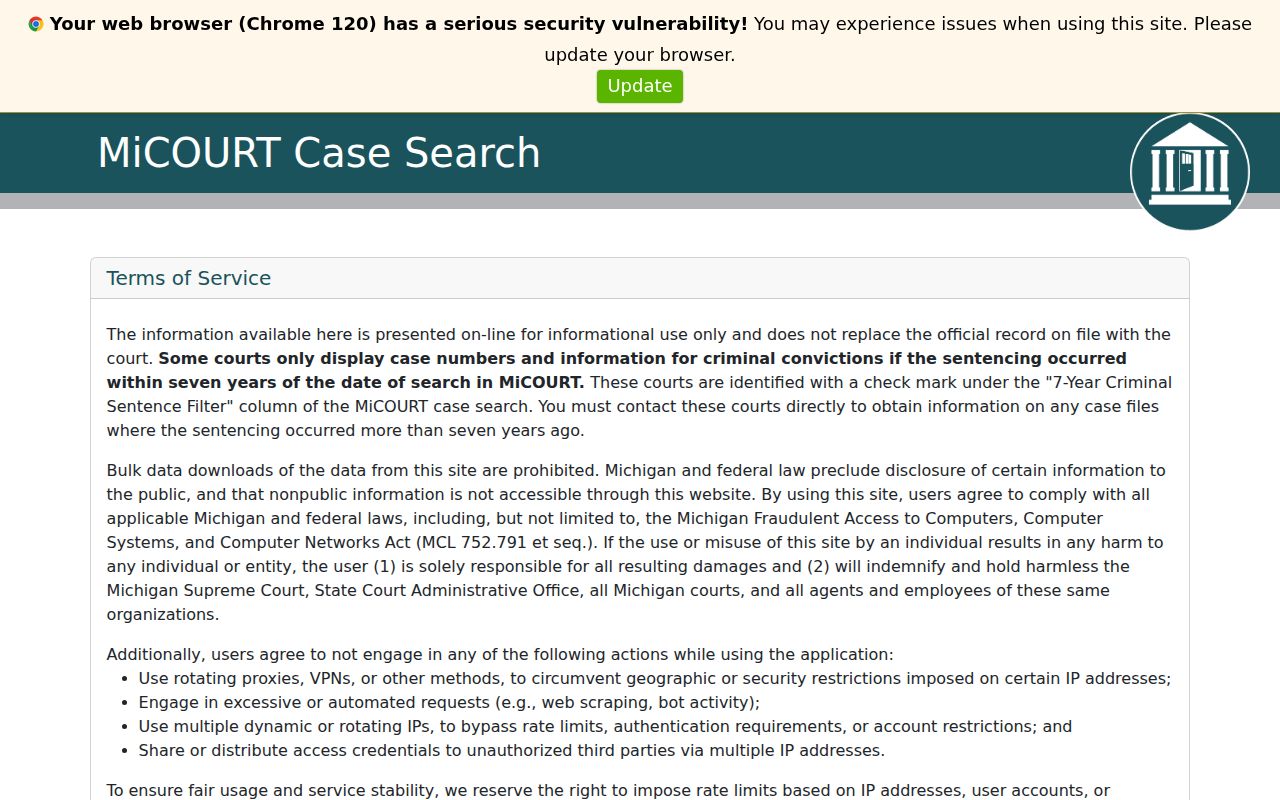
The screenshot helps identify the government search channel, but the docket itself should be checked at both court levels before drawing a conclusion.
Mackinac County Case Record Searches
A case number is the strongest key because names can match. Without one, use the full first and last name, then narrow the result by criminal category, year, status, date of birth, or offense date only as needed. Search both Mackinac courts when a felony outcome is unclear.
- Open MiCOURT and choose the 92nd District Court or 11th Circuit Court in Mackinac County.
- Enter the full case number when known. Otherwise search by the participant's first and last name.
- Limit the results by criminal case category, case year, status, birth date, or filed and offense dates.
- Open the matching docket. Compare the court, case number, charges, event dates, and disposition rather than relying on the name alone.
- Call the proper clerk when a public filing is not attached. Ask about inspection, plain copies, certified copies, archived records, and the current charge.
The official MiCOURT documentation describes these controls and the public data model.
| Field Label | Type | Required | Options or Format |
|---|---|---|---|
| Court | Selector | Yes | Choose 92nd District or 11th Circuit |
| Case Number | Text | Alternative | Year-number-case type pattern |
| First and Last Name | Text | Alternative | Participant-name prefix search |
| Case Type Category | Filter | No | Select criminal to narrow results |
| Case Year and Status | Filters | No | Four-digit year; open, closed, disposed, or deferred |
| Date Fields | Date filters | No | Birth, file, offense, or disposition date |
MiCOURT documentation notes a default result page of 20 entries, offset pagination, and sorting by docket or tracking identifier, newest, or oldest. Those controls can hide an older namesake on a later page. Review all plausible results and use public date fields to narrow them instead of assuming the first name match is correct.
Read Mackinac Court Case Codes
Michigan case numbers commonly follow a year-number-type format. The final letters identify the proceeding category, so they help separate a criminal file from traffic, civil, domestic, or juvenile matters. A status such as “closed” only describes case administration. It does not mean the defendant was acquitted. Read each charge and its disposition.
- Complaint
- The initial sworn charging document.
- Bind-over
- Transfer of a felony from District Court to Circuit Court after probable cause or waiver.
- Information
- The prosecutor-filed felony charge used after bind-over.
- Disposition
- The result of a charge, such as conviction, dismissal, or acquittal.
- Deferred status
- A judgment delayed while the person completes statutory conditions.
Note: A dismissed count does not resolve every other count listed in the same Mackinac County criminal case.
What a Criminal Case File Contains
A Mackinac County case file centers on court action, not the entire police investigation. The docket may identify a filed charge, hearing, attorney role, judgment, and money due. A police narrative remains with the arresting agency unless it was filed publicly with the court. Ask that agency for the incident report.
| Case Number and Court | Identifies the court level, filing year, sequence, and case type. |
|---|---|
| Charging Document | The complaint begins the case; a felony information follows bind-over. |
| Docket Entries | Date-stamped hearings, motions, orders, pleas, and other court events. |
| Hearing Dates | Past events and the next public setting when one is scheduled. |
| Disposition and Judgment | The outcome of each charge and the formal decision of the court. |
| Sentence and Conditions | Public terms imposed after conviction, including financial balances when shown. |
A public file may also show the assigned judge, prosecutor and defense roles, offense and filing dates, and a scheduled hearing. Financial fields can reflect fines or costs but do not tell the whole outcome by themselves. Read the judgment and sentence entries together, and verify an unfamiliar abbreviation with the clerk.
Get Missing Mackinac Case Documents
MiCOURT is an index and docket channel, not a promise that every public paper can be downloaded. Call 92nd District Court at 906-643-7321 for misdemeanor and felony-preliminary material. Call the County Clerk at 906-643-7300 for an 11th Circuit felony file. State whether a plain, certified, archived, or microfilmed copy is needed.
92nd District Court
100 S. Marley St., Room 55
St. Ignace, MI 49781
906-643-7321
Monday through Friday, 8:30 a.m. to 4:30 p.m.
11th Circuit Court Clerk
100 S. Marley St.
St. Ignace, MI 49781
906-643-7300
Call for current inspection and copy options.
Published county court pages do not state copy prices. Obtain a current quote rather than applying the county FOIA paper rate to judiciary records.
For older Mackinac case records, give the clerk the case number if possible, plus the party name and approximate year. Ask whether the file is archived or microfilmed and whether staff can provide a certification. The periodic Mackinac Island court service does not replace the St. Ignace clerk route; call District Court for the dates and the correct place to obtain a copy.
Criminal Case Stages in Mackinac County
A typical felony begins with a complaint and warrant or summons. After arrest or appearance, District Court handles arraignment and bond. A probable-cause conference and preliminary examination follow unless waived. A case supported by probable cause moves to Circuit Court for arraignment on the information, discovery, motions, plea or trial, presentence work, sentence, and a possible appeal.
Case flow: Complaint and warrant or summons › Arrest or appearance › District arraignment and bond › Probable-cause conference › Preliminary examination › Bind-over › Circuit arraignment › Plea or trial › Disposition › Sentencing
District Court also operates the named 92nd District Sobriety Court. Treatment, case-management, provider, and review events can appear on a participant's docket. Those entries reflect court supervision of the program, not a separate criminal case database.
Verify Mackinac MiCOURT Results
MiCOURT can display case number, type, status, filed and offense dates, defendant display name, judge, attorney roles, charges, hearing history, disposition, judgment date, and a financial balance. The public view may not expose every document or developer resource described by its data model.
The official MiCOURT documentation below is the manifest source assigned to Mackinac County court case lookup.
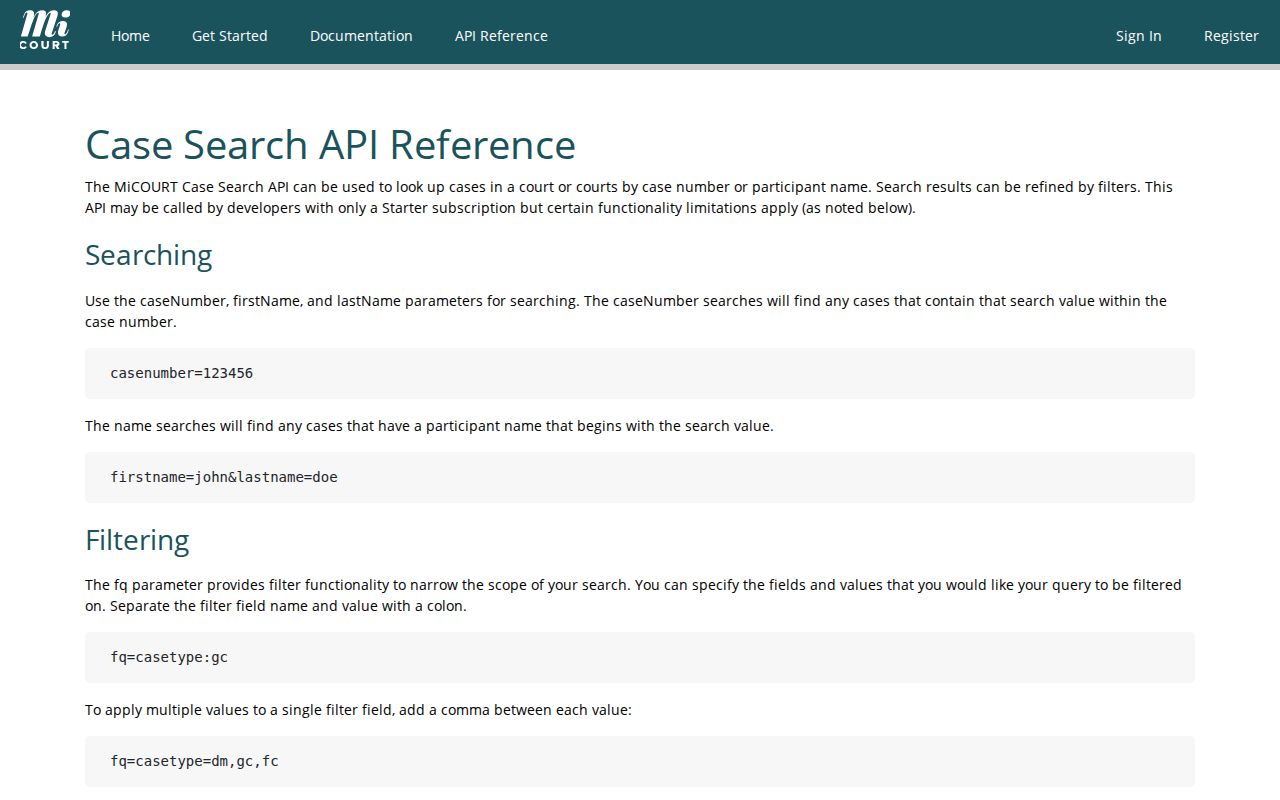
Use those fields to verify identity and chronology. A name match by itself is not proof that the record concerns the intended person.
Access Rules for Case Records
Michigan Court Rule 8.119 governs court-record access, retention, and nonpublic treatment. Michigan courts are excluded from ordinary FOIA, so the county's five-business-day FOIA response rule and ten-cent paper cap do not automatically govern a clerk's judiciary copies.
Juvenile-confidential material, victim information, personal identifiers, sealed files, and convictions set aside under Michigan's set-aside law may be restricted or redacted. When a known case does not appear, ask the clerk whether it is archived, filed at the other court level, nonpublic, or recorded under a different number. The clerk cannot disclose material that law or court order keeps private.
Online access can be narrower than inspection of the public courthouse file. That difference does not make a redacted field public. It also does not prove a missing Mackinac County case was erased. A conviction set aside becomes nonpublic for most purposes, while authorized agencies may retain a nonpublic record as state law permits.
Separate Mackinac Reports from Cases
A court file records prosecution and judicial action. It is not the full arrest narrative, jail intake file, or statewide criminal history. For a police narrative, identify the arresting agency and use its public-record process. For a booking file, contact Mackinac County Jail or the county FOIA coordinator. For reportable Michigan history across counties, use the Michigan State Police Internet Criminal History Access Tool.
This separation explains why records may differ for a time. The Mackinac County Prosecuting Attorney may file a charge different from the arrest allegation, and later court dispositions may not reach every system at the same moment.